Client Logo

Our Solutions

Concrete Polishing

Concrete Floor Repair

Odus Flooring

Epoxy Flooring

Epoxy Repair

Terrazo Flooring

Mosaic Flooring

Use Cases

Concrete Floor Repairing

Warehouse Flooring

Plant Flooring

Hyperstore Flooring

Case Studies

Procter & Gamble

Reliance Industries

Hershey’s India

LG

L&T Constructions

Careers

Internships

Jobs

Resources

Blogs

Team Diaries

Purpose and Passion

Our Story

The Drafting Table

Products

Alkali Resistant Flooring

Odus Dust Block

Terrazzo Flooring

Concrete Polishing Chemicals

Colored Concrete

Fast Curing Additives

Our Solutions
Concrete Polishing

Concrete Floor Repair

Odus Flooring

Epoxy Flooring

Epoxy Repair

Terrazo Flooring

Mosaic Flooring

Use Cases
Concrete Floor Repairing

Warehouse Flooring

Plant Flooring

Hyperstore Flooring

Case Studies
Procter & Gamble

Reliance Industries

Hershey’s India

LG

L&T Constructions

Careers
Internships

Jobs

Resources
Blogs

Team Diaries

Purpose and Passion

Our Story

The Drafting Table

Products
Alkali Resistant Flooring

Odus Dust Block

Terrazzo Flooring

Concrete Polishing Chemicals

Colored Concrete

Fast Curing Additives

Why Warehouse Floors Matter More Than You Think?

Mar 3 • 3 min read

blog_cover

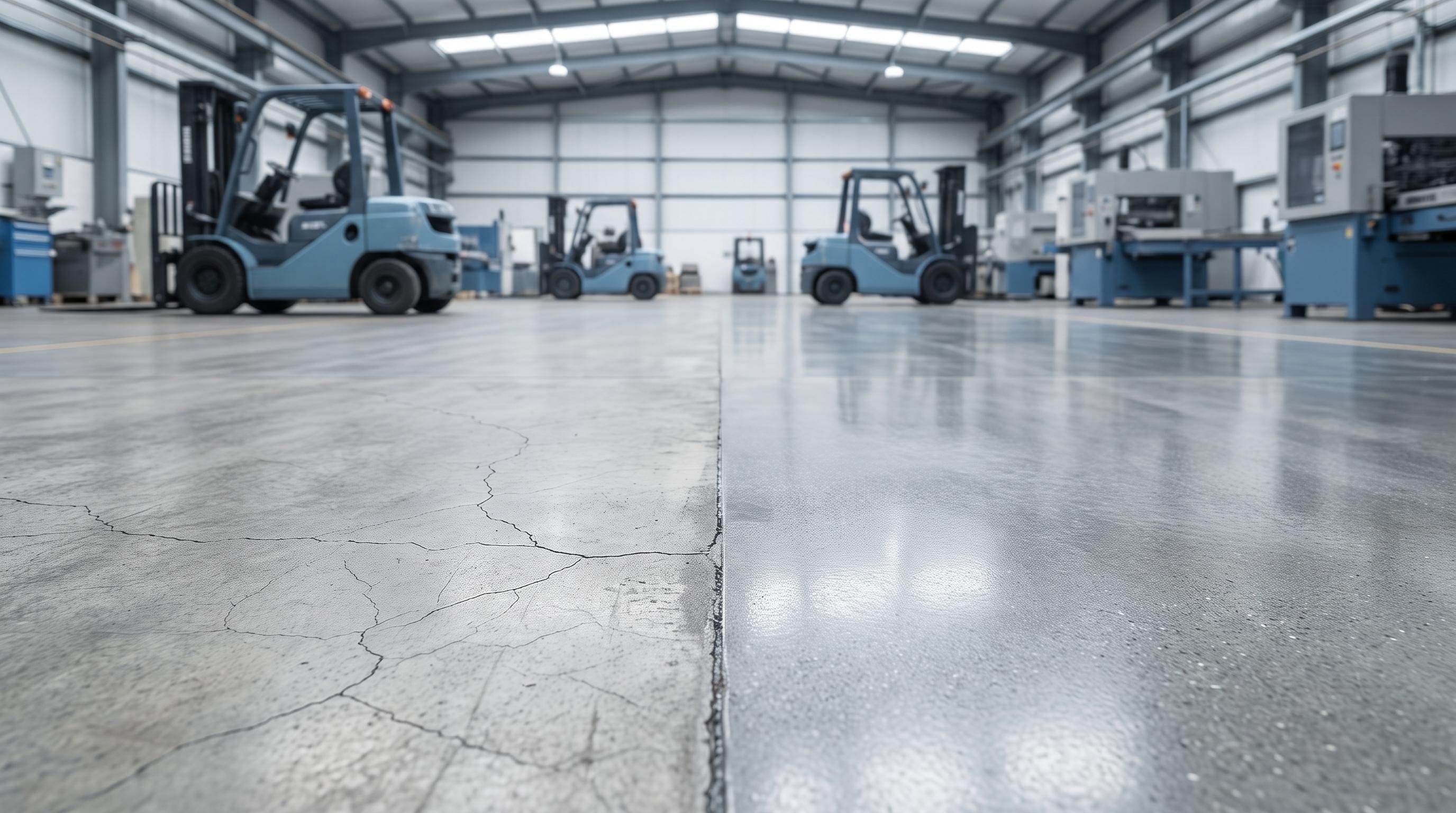
When people think about warehouses, they often focus on storage systems, logistics, and automation. However, one crucial aspect that often goes unnoticed is the warehouse floor. The flooring in a warehouse is more than just a surface to walk or drive on; it plays a vital role in efficiency, safety, and long-term cost savings.

What are the hidden impacts of warehouse flooring?

A warehouse floor directly affects several operational aspects, including:

  • Safety: Uneven, cracked, or slippery floors increase the risk of accidents, leading to potential injuries and downtime.

  • Equipment Longevity: Poor-quality flooring can cause excessive wear and tear on forklifts, pallet jacks, and other machinery, increasing maintenance costs.

  • Operational Efficiency: Smooth and well-maintained floors improve movement efficiency, reducing delays in material handling.

  • Structural Integrity: A weak or poorly constructed floor can lead to cracks and damage, compromising the entire warehouse structure.

  • Audit Compliance: Proper flooring is essential for passing audits, as regulatory bodies often inspect warehouse conditions, including floor quality, for safety and operational standards.

What are the key factors in warehouse flooring?

To maximize warehouse efficiency, it’s essential to consider several factors when selecting and maintaining flooring:

1. Load-Bearing Capacity

Warehouse floors must support heavy loads from racking systems, stacked goods, and moving equipment. Choosing the right flooring material and thickness ensures durability and prevents sinking or cracking under pressure.

2. Surface Coatings

Applying coatings like epoxy, odus, or polished concrete improves floor resilience, resistance to spills, and ease of cleaning. These coatings also enhance visibility with reflectivity, reducing the need for excessive lighting.

3. Slip Resistance

Safety should always be a priority. Non-slip coatings and textured finishes help prevent accidents, particularly in areas prone to spills or moisture.

4. Thermal and Chemical Resistance

In industries where temperature fluctuations or chemical exposure are common, warehouse floors must be resistant to extreme conditions. Specialized flooring solutions, such as resin coatings, protect against chemical corrosion and heat damage.

5. Dust and Debris Control

Dust accumulation can lead to poor air quality and increased maintenance needs. Proper flooring solutions, like sealed concrete or epoxy coatings, help minimize dust generation and make cleaning easier.

6. Static Resistant Flooring

For warehouses that handle sensitive electronic equipment or flammable materials, static-resistant flooring is essential. This type of flooring prevents the buildup of static electricity, reducing the risk of sparks that could damage electronic components or cause hazardous incidents.

What are the common warehouse flooring solutions?

Choosing the right flooring depends on the type of warehouse operations. Here are some commonly used options:

  • Polished Concrete: Highly durable, low-maintenance, and cost-effective for heavy-duty warehouses.

  • Odus: Odus Flooring is a more durable and long lasting alternative to Concrete Polishing. Which provides a smooth, durable, chemical resistant, forklift proof and abrasion resistant flooring.

  • Epoxy Flooring: Provides a smooth surface ideal for industrial environments. But it needs to be repaired after every 6-7 months.

  • Vinyl and Rubber Flooring: Suitable for warehouses requiring comfort and noise reduction.

  • Interlocking Tiles: A flexible and easy-to-install option for temporary or modular warehouse setups.

  • Static Dissipative Flooring: A crucial option for environments where electrostatic discharge can be a risk.

    To read more about anti-static flooring: https://www.rezovate.com/blogs-for-industries/anti-static-epoxy-flooring-esd-flooring-a-detailed-guide-rr

The Cost of Neglecting Warehouse Floors

Ignoring warehouse floor maintenance can lead to:

  • Frequent Repairs: Cracks and potholes can develop, requiring costly and disruptive repairs.

  • Safety Incidents: Slip and fall accidents can lead to worker injuries and liability claims.

  • Equipment Downtime: Damaged floors can negatively impact machinery performance, leading to operational disruptions.

  • Failed Audits: Poor flooring conditions can result in non-compliance with safety and operational regulations, leading to penalties or operational halts.

Conclusion

Warehouse floors are an important part of industrial operations. Investing in high-quality flooring and regular maintenance ensures safety, efficiency, and cost-effectiveness. Don’t overlook your warehouse floor—it's the foundation of your business success!

Our Clients

Hershey's
L&T Construction
LG
P&G
Yanjan
Eicher
Reliance
Icon

India's Best Industrial and Commercial Flooring Solution Provider

Trusted by 200+ clients. We provide flooring services and supply products for all sorts of Industrial flooring. Call us at +917869964996 or share contact details by filling the form below:

Related Blogs

Elements of Construction: Terrazzo

Elements of Construction: Terrazzo

Terrazzo began as a practical solution—an inventive way to reuse stone fragments—and evolved into one of architecture’s most enduring finishes. From ancient pavements to Venetian craftsmanship and modern public landmarks, terrazzo’s story is one of sustainability, durability, and timeless design.

Dec 16,2025

2 min

Elements of Construction: Duct Tape

Elements of Construction: Duct Tape

Duct tape wasn’t meant to be iconic. It was meant to solve a problem. Born out of necessity during wartime, it quietly went on to become one of the most relied-upon materials on construction sites everywhere, proof that the simplest ideas often leave the biggest impact.

Dec 16,2025

2 min

Elements of Construction: Teflon

Elements of Construction: Teflon

Teflon was never meant for buildings. Discovered by accident while searching for a safer refrigerant gas, its refusal to react with almost anything turned it into one of construction’s underrated materials—protecting structures from corrosion, heat and damage.

Jan 21,2026

2 min

Why is India a Hotspot for Global Investors?

Why is India a Hotspot for Global Investors?

India ranks 5th globally, with 6.8% GDP growth, vast market, young population, UPI leadership, reforms, and 100% FDI in most sectors—making it a prime investment hotspot.

Feb 25,2026

8 min

Elements of Construction: Paints

Elements of Construction: Paints

Historically, wall colors from natural pigments like ultramarine (from lapis lazuli), lead white, mercury vermilion, and arsenic green were luxurious but highly toxic, involving dangerous mining, trade, and application that poisoned artisans. Paint was a labor-intensive process driven by experience, not safety. The Industrial Revolution brought synthetic pigments, making paint safe, scalable, and functional—protecting buildings from corrosion, fire, and weathering. Modern architecture benefits from engineered coatings, but today's safe colors echo a violent past of risk and human sacrifice.

Jan 06,2026

2 min

Elements of Construction: Plywood

Elements of Construction: Plywood

Plywood may seem like a modern construction staple, but its origins stretch back thousands of years. What began as an ancient technique of layering veneers for stability evolved through industrial innovation into a lightweight, high-strength material. Its true breakthrough came during World War I, where its speed, durability, and strength-to-weight ratio made it indispensable for aircraft and rapid construction—cementing plywood’s place as a foundational material of modern building.

Dec 16,2025

2 min

Elements of Construction: Terrazzo

Elements of Construction: Terrazzo

Terrazzo began as a practical solution—an inventive way to reuse stone fragments—and evolved into one of architecture’s most enduring finishes. From ancient pavements to Venetian craftsmanship and modern public landmarks, terrazzo’s story is one of sustainability, durability, and timeless design.

Dec 16,2025

2 min

Elements of Construction: Duct Tape

Elements of Construction: Duct Tape

Duct tape wasn’t meant to be iconic. It was meant to solve a problem. Born out of necessity during wartime, it quietly went on to become one of the most relied-upon materials on construction sites everywhere, proof that the simplest ideas often leave the biggest impact.

Dec 16,2025

2 min

Elements of Construction: Teflon

Elements of Construction: Teflon

Teflon was never meant for buildings. Discovered by accident while searching for a safer refrigerant gas, its refusal to react with almost anything turned it into one of construction’s underrated materials—protecting structures from corrosion, heat and damage.

Jan 21,2026

2 min

Why is India a Hotspot for Global Investors?

Why is India a Hotspot for Global Investors?

India ranks 5th globally, with 6.8% GDP growth, vast market, young population, UPI leadership, reforms, and 100% FDI in most sectors—making it a prime investment hotspot.

Feb 25,2026

8 min

Elements of Construction: Paints

Elements of Construction: Paints

Historically, wall colors from natural pigments like ultramarine (from lapis lazuli), lead white, mercury vermilion, and arsenic green were luxurious but highly toxic, involving dangerous mining, trade, and application that poisoned artisans. Paint was a labor-intensive process driven by experience, not safety. The Industrial Revolution brought synthetic pigments, making paint safe, scalable, and functional—protecting buildings from corrosion, fire, and weathering. Modern architecture benefits from engineered coatings, but today's safe colors echo a violent past of risk and human sacrifice.

Jan 06,2026

2 min

Elements of Construction: Plywood

Elements of Construction: Plywood

Plywood may seem like a modern construction staple, but its origins stretch back thousands of years. What began as an ancient technique of layering veneers for stability evolved through industrial innovation into a lightweight, high-strength material. Its true breakthrough came during World War I, where its speed, durability, and strength-to-weight ratio made it indispensable for aircraft and rapid construction—cementing plywood’s place as a foundational material of modern building.

Dec 16,2025

2 min

Elements of Construction: Terrazzo

Elements of Construction: Terrazzo

Terrazzo began as a practical solution—an inventive way to reuse stone fragments—and evolved into one of architecture’s most enduring finishes. From ancient pavements to Venetian craftsmanship and modern public landmarks, terrazzo’s story is one of sustainability, durability, and timeless design.

Dec 16,2025

2 min

Elements of Construction: Duct Tape

Elements of Construction: Duct Tape

Duct tape wasn’t meant to be iconic. It was meant to solve a problem. Born out of necessity during wartime, it quietly went on to become one of the most relied-upon materials on construction sites everywhere, proof that the simplest ideas often leave the biggest impact.

Dec 16,2025

2 min

Elements of Construction: Teflon

Elements of Construction: Teflon

Teflon was never meant for buildings. Discovered by accident while searching for a safer refrigerant gas, its refusal to react with almost anything turned it into one of construction’s underrated materials—protecting structures from corrosion, heat and damage.

Jan 21,2026

2 min