
Feb 25 • 8 min read

India has emerged as a top destination for investors worldwide, driven by its rapid economic growth, digital revolution, and consistent policy reforms.
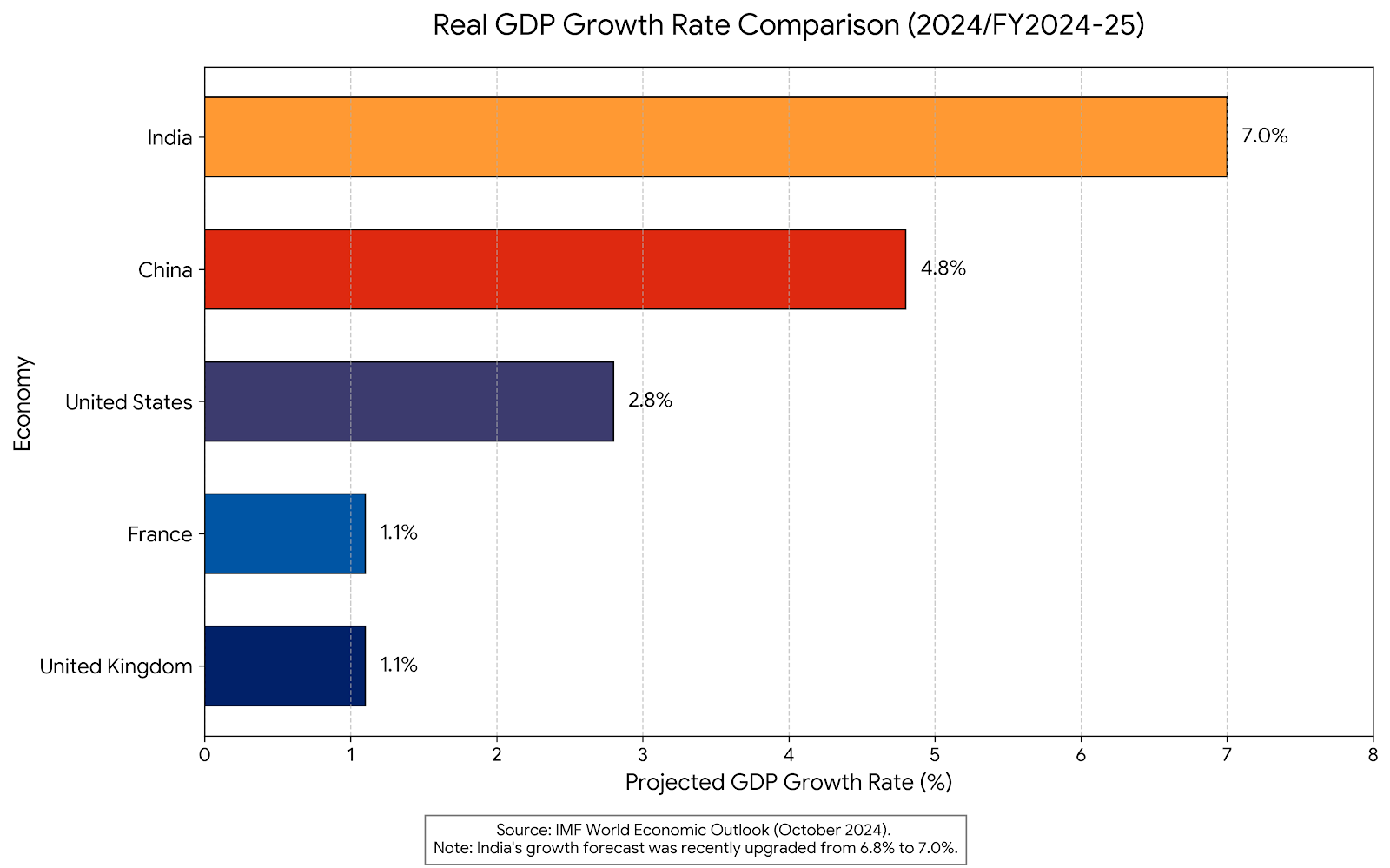
According to the International Monetary Fund (IMF), India has climbed to the 5th spot globally, overtaking the UK and France, and now contributes over 7% to the world's GDP growth. With a projected GDP growth rate of 6.8% in FY2024-25, India is outpacing major economies like the US and China.
What makes India an attractive investment hub?
1. Vast Market Potential
1.4 billion consumers with increasing purchasing power
A young population with over 65% under 35
India's urban population is expanding at a rate of ~2.3% annually, creating new opportunities and demand across sectors.
2.India's Economic Resilience and Growth Prospects
Robust Growth Trajectory: India's GDP is projected to grow at 6-7% annually until 2030, signaling a strong economic outlook.
Key Sectors Driving FDI: Services, manufacturing, IT, and renewable energy are among the top sectors attracting foreign investment, with shares of 18%, 17%, 12%, and 10%, respectively.
Digital Payments Leader: India has achieved a remarkable milestone with over 90 billion UPI transactions in FY24, boasting the world's most used payment system.
Future-Ready Economy: With its stable economy, ongoing reforms, and vast market potential, India is poised to be a premier investment destination.
3.India's Strategic Advantage for Global Trade
Geographical Gateway: India's location enables it to serve as a trade bridge between Asia, the Middle East, and Africa.
Trade Pacts: India has signed significant trade agreements, including CEPA with Japan and South Korea, and strong partnerships with ASEAN and the EU.
World-Class Infrastructure: 12 major ports and ongoing development of logistics corridors under the National Infrastructure Pipeline (NIP) support efficient trade operations.
Ideal Hub for Exports: India's strategic location and infrastructure make it an attractive base for foreign investors looking to export and operate in the region.
4. Skilled Talent Pool
Over 1.5 million engineers and 3 million graduates annually
Cost-effective and English-speaking workforce
5. Business-Friendly Environment
Streamlined reforms under initiatives like Make in India and Digital India
Simplified compliance and 100% FDI allowed in most sectors
6. Infrastructure and Digital Advancements
$1.4 trillion investment pipeline in national infrastructure
Robust digital infrastructure such as UPI, ONDC, Aadhaar, and DigiLocker supports seamless business operations.
Establishing a foreign business in India requires a thorough understanding of the country's regulatory framework, which prioritizes compliance, transparency, and investor protection. Various entry routes, business structures are available, including wholly owned subsidiaries, joint ventures, and branch offices, each with its own set of rules and approvals. To set up and operate successfully, it's crucial to grasp India's Foreign Direct Investment policy, sector-specific regulations, and business laws.
What is the Legal Framework for Governing FDI in India?
Regulatory Body / Law | Scope & Objective | Significant Provisions (2025 Status) |
Foreign Exchange Management Act (FEMA), 1999 | Supervises all international financial flows, including capital and current account dealings. | Under RBI oversight, all capital injections, profit transfers, and share issuances must follow strict protocols. Investors are required to document transactions via the Single Master Form (SMF) within a 30-day window. |
Companies Act, 2013 | Regulates the entire lifecycle of a business, from initial registration to day-to-day governance. | Mandatory for all Wholly Owned Subsidiaries (WOS) and Joint Ventures (JVs). Key requirements include appointing at least one resident Indian director and managing all statutory submissions through the MCA V3 digital platform. |
DPIIT’s Consolidated FDI Policy | Establishes the investment thresholds (caps) and entry pathways for various industries. | While the majority of sectors permit 100% foreign equity via the Automatic Route, specific "sensitive" areas—such as news media, defense, and multi-brand retail—necessitate formal Government Authorization. |
What are the key regulatory bodies for FDI in India?
Governing Body / Platform | Primary Responsibility |
Reserve Bank of India (RBI) | Acts as the watchdog for currency stability and FEMA adherence. It oversees the approval of specialized setups like liaison or project offices and monitors all international monetary inflows and outflows. |
Department for Promotion of Industry and Internal Trade (DPIIT) | The chief architect of India’s FDI guidelines. It is responsible for drafting, revising, and announcing the specific percentage limits (caps) and entry pathways for different industrial sectors. |
Ministry of Corporate Affairs (MCA) | The primary administrator for the legal lifecycle of a company. It manages the digital registration of new entities and ensures businesses remain transparent through mandatory annual compliance and financial filings. |
Foreign Investment Facilitation Portal (FIFP) | Serving as a centralized processing hub, this platform manages investment applications that fall under the "Government Route," ensuring a streamlined, single-window clearance for complex proposals. |
Business Structure | Distinguishing Features & Scope | Regulatory Authority |
Wholly Owned Subsidiary (WOS) | Offers total foreign equity, providing the parent company with absolute management autonomy. There is no floor on initial funding, and it functions as a full-scale Indian legal entity. | MCA (Companies Act) & RBI (FEMA) |
Joint Venture (JV) | A collaborative partnership with a domestic Indian firm. It is ideal for leveraging the local partner’s market insights, distribution networks, and established brand presence. | MCA & DPIIT |
Branch Office (BO) | Operates as an extension of the foreign parent for commercial activities. It can generate revenue in India but is restricted to specific sectors like export/import and professional services. | RBI Authorization |
Liaison Office (LO) | Acts purely as a representative hub for communication and networking. It is prohibited from engaging in any commercial or profit-making activities; all expenses must be funded from abroad. | RBI Authorization |
Project Office (PO) | A temporary establishment created specifically to execute a defined contract or project in India. Its existence is strictly tied to the project’s duration and scope of work. | RBI Authorization |
There are two primary routes for Foreign Direct Investment (FDI) in India:The Automatic Route for Foreign Direct Investment (FDI) and the Government Route for Foreign Direct Investment (FDI).
Route | Authorization Protocol | Example of eligible sectors | Regulatory Body |
Automatic route | No advance permission is required from the government; investors simply notify the authorities after the transaction. | Information Technology, Software Development, Industrial Manufacturing, and Green Energy. | RBI (Reserve Bank of India) & DPIIT |
Government Route | Mandatory vetting and clearance through the Foreign Investment Facilitation Portal (FIFP) before any capital injection. | Defense Production, Specialized Retail, News & Media, and Insurance (exceeding specific caps). | DPIIT & the respective Administrative Ministry |
Corporate Configuration | Setup Duration | Key Influencing Factors |
Wholly Owned Subsidiary (WOS) | 15–20 Days | Operates as a Private Limited Company. Speed is dictated by the uniqueness of the chosen name and the precision of the filing paperwork. |
Joint Venture (JV) | 15–20 Days | Parallel to a WOS, though the timeline can shift based on the complexity of shareholder agreements and local regulatory clearances. |
Branch Office (BO) | 20–30 Days | Necessitates RBI authorization. The global parent must demonstrate a consistent profit history over the preceding five financial years. |
Liaison Office (LO) | 20–30 Days | Subject to RBI vetting. The parent firm must show three years of profitability. Restricted to non-revenue generating activities. |
Project Office (PO) | 15–25 Days | Established for the duration of a specific contract. Timing varies based on the scope of the project and sector-specific permissions. |
Since a Wholly Owned Subsidiary is the preferred choice for most global investors due to its operational independence. Here is the breakdown of its registration cycle.
Phase of Incorporation | Estimated Time | Description |
Digital Credentials | 1–3 Days | Acquisition of the Digital Signature Certificate (DSC) and Director Identification Number (DIN). |
Name Reservation | 2–5 Days | Reservation of the corporate name via the RUN (Reserve Unique Name) service. Rejections can extend this window. |
Document Submission | 5–10 Days | Drafting and filing the integrated SPICe+ form, including the Charter (MoA) and Bylaws (AoA). |
Legal Certification | 1–3 Days | Review by the Registrar of Companies (RoC) and the formal issuance of the Certificate of Incorporation (CoI). |
Setting up a business in India involves various expenses that depend on the chosen business structure. These costs can be broadly categorized into one-time incorporation costs and recurring operational expenses. Understanding these costs is essential for effective financial planning.
One-Time Incorporation Costs:
Government Fees: Fees for name approval, incorporation documents, and other filings, which vary based on the company's authorized capital.
Stamp Duty: A state-specific tax on legal documents, with rates differing across states.
Digital Signature Certificate (DSC) and Director Identification Number (DIN): Mandatory for online filings, with costs applicable per director.
Professional Fees: Charges for services from chartered accountants, lawyers, and incorporation specialists.
Ongoing Operational Expenses:
Registered Office Rent: Costs associated with maintaining a physical office space.
Annual Compliance Fees: Fees for mandatory annual filings with regulatory authorities.
Statutory Audit Fees: Annual audit costs, which depend on the company's turnover and complexity.
Accounting and Bookkeeping: Expenses for maintaining financial records.
Payroll and HR: Costs related to employee salaries, benefits, and other HR expenses.
Category | Estimated Cost (INR) | Estimated Cost (USD) | Notes |
Government Fees (MCA/ROC) | ₹5,000 – ₹25,000 | $60 – $300 | Scale based on authorized capital. |
Stamp Duty | ₹500 – ₹15,000+ | $6 – $180+ | Delhi: 0.15% on capital; Maharashtra: ~₹1,000 per ₹5L capital. |
DSC & DIN | ₹2,000 – ₹5,000 | $25 – $60 | Per director. Includes Digital Signature and ID Number. |
Professional Fees | ₹15,000 – ₹75,000+ | $180 – $900+ | Higher for foreigners due to FDI/FEMA and apostille needs. |
Total (Domestic) | ₹40,000 – ₹1,50,000 | $500 – $1,800 | Standard local entity setup. |
Total (Foreign Sub) | ₹60,000 – ₹2,50,000 | $720 – $3,000 | Includes extra legalizing/FEMA paperwork. |
Category | Estimated Annual Cost | Notes |
Registered Office Rent | ₹10,000 – ₹1,00,000+ | Virtual offices are cheaper (~₹15k–₹25k/yr). |
Annual ROC Filings | ₹5,000 – ₹30,000 | Includes AOC-4 (Financials) and MGT-7 (Annual Return). |
Statutory Audit Fees | ₹25,000 – ₹1,00,000+ | Mandatory for all Pvt Ltd companies regardless of turnover. |
Accounting & Bookkeeping | ₹10,000 – ₹50,000+ | Often outsourced to boutique firms for small entities. |
FEMA/RBI Compliance | ₹10,000 – ₹25,000 | Specific to foreign entities (FC-GPR filings, etc.). |
Payroll & HR | Variable | Starts from zero if no local staff are hired yet. |
No, Indian residency is not a requirement for company registration. However, it's mandatory to have at least one director who is a resident of India.
Yes, having a registered office address in India is a requirement for all companies. To fulfill this requirement, many businesses opt for virtual office solutions that meet compliance standards.
Yes, foreigners can register a company in any city in India. Choosing a hub like Bengaluru or Mumbai can offer advantages like faster growth and easier compliance.


Related Blogs