Client Logo

Our Solutions

Concrete Polishing

Concrete Floor Repair

Odus Flooring

Epoxy Flooring

Epoxy Repair

Terrazo Flooring

Mosaic Flooring

Use Cases

Concrete Floor Repairing

Warehouse Flooring

Plant Flooring

Hyperstore Flooring

Case Studies

Procter & Gamble

Reliance Industries

Hershey’s India

LG

L&T Constructions

Careers

Internships

Jobs

Resources

Blogs

Team Diaries

Purpose and Passion

Our Story

The Drafting Table

Products

Alkali Resistant Flooring

Odus Dust Block

Terrazzo Flooring

Concrete Polishing Chemicals

Colored Concrete

Fast Curing Additives

Our Solutions
Concrete Polishing

Concrete Floor Repair

Odus Flooring

Epoxy Flooring

Epoxy Repair

Terrazo Flooring

Mosaic Flooring

Use Cases
Concrete Floor Repairing

Warehouse Flooring

Plant Flooring

Hyperstore Flooring

Case Studies
Procter & Gamble

Reliance Industries

Hershey’s India

LG

L&T Constructions

Careers
Internships

Jobs

Resources
Blogs

Team Diaries

Purpose and Passion

Our Story

The Drafting Table

Products
Alkali Resistant Flooring

Odus Dust Block

Terrazzo Flooring

Concrete Polishing Chemicals

Colored Concrete

Fast Curing Additives

Elements of Construction: Paints

Jan 6 • 2 min read

blog_cover

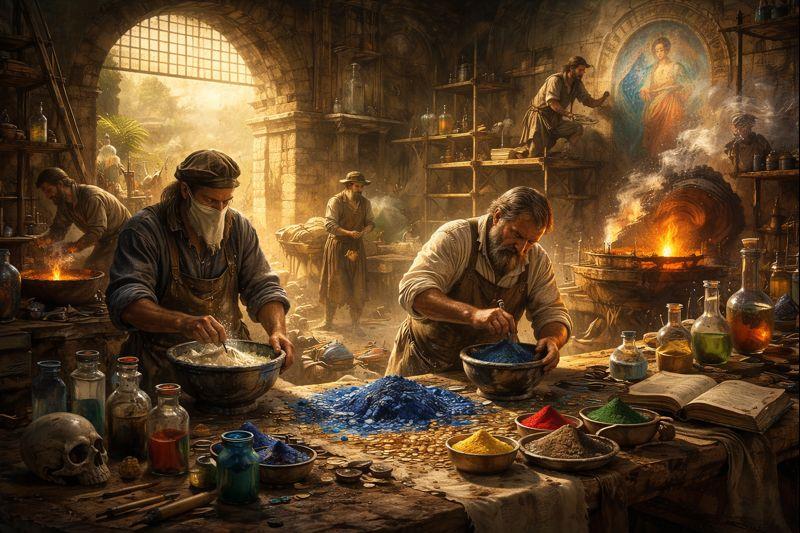
When color was first applied to walls, it was never harmless. Long before paint arrived in tidy cans and technical datasheets, color was a dangerous luxury. Pigments were not manufactured materials, but substances wrestled directly from the earth. They were mined, crushed, burned, dissolved, and traded across continents, often at immense human cost. Ultramarine, blue, made from lapis lazuli quarried in the mountains of Afghanistan, was once worth more than gold and reserved for sacred architecture and royal commissions. White came from lead, prized for its opacity yet quietly lethal to those who prepared and applied it. Vermilion emerged from mercury ores, emerald green from arsenic compounds. Simply mixing colors exposed painters and builders to slow, invisible poisoning. Every shade carried a story, and every story carried a price.

For most of history, paint was not a product but a process. From prehistoric cave walls stained with iron-rich ochre to lime-washed interiors of ancient and medieval buildings, color demanded manual labor, patience, and risk. Artisans ground minerals with stone tools, mixed binders by intuition, and tested finishes directly on walls. Pigments moved along the same trade routes as timber, stone, silk, and spices, making color one of the earliest global building materials. This was chemistry long before chemistry had a name, driven by observation rather than theory and survival rather than safety. Applying color to architecture meant understanding materials through experience, not instruction, and enduring the consequences of that knowledge.
The turning point came when color shifted from earth to engineering. With the Industrial Revolution, pigments began to leave mines and workshops and enter laboratories. Chance was replaced by control. Natural minerals were stabilized, modified, or substituted through synthetic chemistry. Dangerous compounds were studied, regulated, or abandoned. Paint became predictable, repeatable, and scalable, capable of covering entire cities rather than a single chamber or façade. What once took weeks of grinding stone and testing mixtures could now be achieved in controlled reactors and formulation labs within hours.

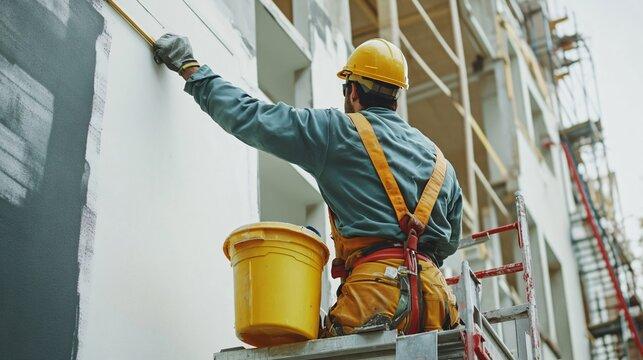
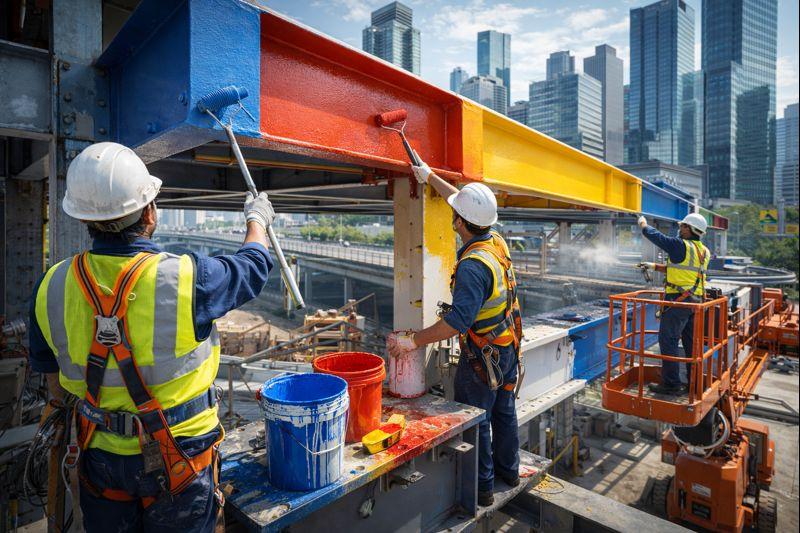
This transformation quietly changed architecture. Paint ceased to be merely decorative and became part of a building’s performance. Modern coatings protect steel from corrosion, concrete from carbonation, and façades from ultraviolet radiation and pollution. Fire-resistant paints delay structural failure, reflective coatings reduce heat gain, and protective systems extend the life of bridges, towers, and infrastructure. For architects and construction professionals, paint is no longer a final layer applied at the end of a project. It is part of the building envelope, mediating between structure, climate, and time itself.
Yet behind every smooth wall and flawless surface lies a violent and deeply human history. Miners extracted toxic minerals, merchants transported them across hostile terrain, and painters absorbed their dangers daily so color could exist in the built environment. What was once crushed stone and silent poisoning is now regulated science and engineered safety. The colors shaping today’s skylines carry within them the memory of risk, experimentation, and sacrifice. Every wall remembers, even if we no longer do.

Our Clients

Hershey's
L&T Construction
LG
P&G
Yanjan
Eicher
Reliance
Icon

India's Best Industrial and Commercial Flooring Solution Provider

Trusted by 200+ clients. We provide flooring services and supply products for all sorts of Industrial flooring. Call us at +917869964996 or share contact details by filling the form below:

Related Blogs

Elements of Construction: Duct Tape

Elements of Construction: Duct Tape

Duct tape wasn’t meant to be iconic. It was meant to solve a problem. Born out of necessity during wartime, it quietly went on to become one of the most relied-upon materials on construction sites everywhere, proof that the simplest ideas often leave the biggest impact.

Dec 16,2025

2 min

Elements of Construction: Teflon

Elements of Construction: Teflon

Teflon was never meant for buildings. Discovered by accident while searching for a safer refrigerant, its refusal to react with almost anything turned it into one of construction’s quiet super-materials—protecting structures from corrosion, friction, heat, and time itself.

Dec 16,2025

2 min

Elements of Construction: Aluminium

Elements of Construction: Aluminium

Once rarer than gold, aluminum was hidden in plain sight—locked inside ordinary earth. What began as a scientific curiosity soon became the metal that reshaped skylines, lightened structures, and defined modern construction. This is the quiet journey of a material that moved from the ground beneath our feet to the face of the modern city.

Dec 16,2025

3 min

Elements of Construction: Plywood

Elements of Construction: Plywood

Plywood may seem like a modern construction staple, but its origins stretch back thousands of years. What began as an ancient technique of layering veneers for stability evolved through industrial innovation into a lightweight, high-strength material. Its true breakthrough came during World War I, where its speed, durability, and strength-to-weight ratio made it indispensable for aircraft and rapid construction—cementing plywood’s place as a foundational material of modern building.

Dec 16,2025

2 min

Elements of Construction: Terrazzo

Elements of Construction: Terrazzo

Terrazzo began as a practical solution—an inventive way to reuse stone fragments—and evolved into one of architecture’s most enduring finishes. From ancient pavements to Venetian craftsmanship and modern public landmarks, terrazzo’s story is one of sustainability, durability, and timeless design.

Dec 16,2025

2 min

Elements of Construction: Duct Tape

Elements of Construction: Duct Tape

Duct tape wasn’t meant to be iconic. It was meant to solve a problem. Born out of necessity during wartime, it quietly went on to become one of the most relied-upon materials on construction sites everywhere, proof that the simplest ideas often leave the biggest impact.

Dec 16,2025

2 min

Elements of Construction: Teflon

Elements of Construction: Teflon

Teflon was never meant for buildings. Discovered by accident while searching for a safer refrigerant, its refusal to react with almost anything turned it into one of construction’s quiet super-materials—protecting structures from corrosion, friction, heat, and time itself.

Dec 16,2025

2 min

Elements of Construction: Aluminium

Elements of Construction: Aluminium

Once rarer than gold, aluminum was hidden in plain sight—locked inside ordinary earth. What began as a scientific curiosity soon became the metal that reshaped skylines, lightened structures, and defined modern construction. This is the quiet journey of a material that moved from the ground beneath our feet to the face of the modern city.

Dec 16,2025

3 min

Elements of Construction: Plywood

Elements of Construction: Plywood

Plywood may seem like a modern construction staple, but its origins stretch back thousands of years. What began as an ancient technique of layering veneers for stability evolved through industrial innovation into a lightweight, high-strength material. Its true breakthrough came during World War I, where its speed, durability, and strength-to-weight ratio made it indispensable for aircraft and rapid construction—cementing plywood’s place as a foundational material of modern building.

Dec 16,2025

2 min

Elements of Construction: Terrazzo

Elements of Construction: Terrazzo

Terrazzo began as a practical solution—an inventive way to reuse stone fragments—and evolved into one of architecture’s most enduring finishes. From ancient pavements to Venetian craftsmanship and modern public landmarks, terrazzo’s story is one of sustainability, durability, and timeless design.

Dec 16,2025

2 min

Elements of Construction: Duct Tape

Elements of Construction: Duct Tape

Duct tape wasn’t meant to be iconic. It was meant to solve a problem. Born out of necessity during wartime, it quietly went on to become one of the most relied-upon materials on construction sites everywhere, proof that the simplest ideas often leave the biggest impact.

Dec 16,2025

2 min

Elements of Construction: Teflon

Elements of Construction: Teflon

Teflon was never meant for buildings. Discovered by accident while searching for a safer refrigerant, its refusal to react with almost anything turned it into one of construction’s quiet super-materials—protecting structures from corrosion, friction, heat, and time itself.

Dec 16,2025

2 min

Elements of Construction: Aluminium

Elements of Construction: Aluminium

Once rarer than gold, aluminum was hidden in plain sight—locked inside ordinary earth. What began as a scientific curiosity soon became the metal that reshaped skylines, lightened structures, and defined modern construction. This is the quiet journey of a material that moved from the ground beneath our feet to the face of the modern city.

Dec 16,2025

3 min